The Science of Last Things
Author: Ellen Wayland-Smith Full Title: The Science of Last Things: Essays on Deep Time and the Boundaries of the Self Category: Books Date Finished: February 10, 2025 Date Read: 2025/02/10 Genre: Nonfiction
Preface, X
In Aesop’s fable, the turtle, loath to leave the comfort of her home, declines an invitation to Zeus’s wedding celebration. For this breach of etiquette, Zeus condemns her to wander the world lugging her home on her back in perpetuity.
XIII
The mystery of the self, then, is that every atom of our being is on loan from the universe, at every instant, from time immemorial…Humans don’t much like to acknowledge this loan, most likely because our brains work at time scales supremely unsuited to appreciate the nearly four-billion-year-long game of biological life on earth. We are a prideful species, hesitate to claim kinship with the primeval bubbling ooze that started the whole ball rolling.
To live with one eye fixed on geochemical and biological “deep time” is to practice radical humility, in the most literal sense of the world: humilitas, from humus, the Latin word for “earth.”
“Gravity”, pg 11: Essay on pain, falling, labor, death
The term “labor” is far too active a word, implying volition, effort. This is true up to a point, but at bottom, as Maggie Nelson rightly points out, the labor of childbirth isn’t something you do; “labor does you.”
Pain is indeed a reminder of finitude, a claim on our obedience to something outside the self. It makes us an offer we can’t refuse.
What I learned in labor: to be obedient to the mystery of something that surpasses not only the limits of your physical capacity to suffer, but of your capacity to know. Man is not the measure of all things. There is the measureless, and when you encounter it, you get the vanity knocked clean of you.
“Corpus Christi”, pg 25: Essay on communion, christianity, digestion
For what, after all, is metabolism, this endless loop of eating and being eaten, if not the chemical expression of the most ancient myth of all: the cyclical death of the earth (god); its dispersal, ingestion, and rebirth; the original splitting that consecrates our oneness; the cosmic molecular arc that binds all life?
“Outis”, pg 42: Essay on going mad, dissociation, depression, what is ‘self’
So too, in the Unpanishads, the pilgrim seeking the nature of the All-Being or Brahman can do so only obliquely, through and endless process of subtraction: neti, neti—not this, not that.
The I is a grammatical impossibility in the syntax of the encounter with the Absolute, whether void or plentitude, nothing or everything…Both encounters—void, all—involve a form of rapture, the absconding of the I, and both encounters disable the familiar relations of knowing and choice that characterize interaction with objects in our day-to-day dealings with the world.
When even despair, as a fixed and chosen relation to the outside world around which one might build a self, was out of reach. It left me with an abiding awareness of the temporary, make-shift nature of this I—splinter of a spar, clift of a rock—that at any given moment holds me safe.
“Body Map”: Essay on self, child, proprioception, phantom limb
pg 47
After giving birth, wherever you are, there you are not, quite, or not quite all. There is a noncontiguous fraction of you extended in space, another self outside yourself, to which, from now to eternity, you are joined. Even if one or the other or both of you should disappear: absence or distance, even the ultimate distance of death, alters not one jot the ghostly geography of this new personhood.
pg 54
It is only by slipping into the borrowed skins of these others—inhabiting their envelopes, internalizing their outlines—that I first become a self.
The other is, then, not “another” myself; it is rather closer to the truth to say that the self is another *other…*It means the self is never whole to begin with, is always something of a knockoff. Pythagoras’s monad without the dyad—the one without the two—is no-thing. This elemental fact of embodied existence, this secret neural overlap of first and third person perspectives, without which there would be no shared world at all, remains largely unconscious in our day-to-day functioning. It is only when we are cast into certain liminal states—like physically birthing another body, creating two out of one—that we sometimes catch a glimpse of the other we always already are.
“American Pastoral”, pg 73: Essay on lake decay
The dream of a pristine state of nature has always been a ruse—innocence recollected from the rueful perspective of experience, which is to say, not innocent at all.
“This Ragged Claw”, pg 94: Essay on cancer diagnosis / results
“There’s nothing to do but wait,” we tell ourselves. Then the prescription is delivered; the sky clears; the phone rings—and off we go again, our power to do and to be is mercifully restored.
But there is a larger waiting, a cosmic waiting that precedes and cradles within itself all the other times and modes and tenses of being, like drops of water in an ocean. It tells us that our puny power to do and to be in this world is the exception, not the rule; that waiting is not the suspension of human business-as-usual, but rather the oldest and most elemental form of time.
The modern English verb to wait derives from a trio of Old English roots indicating states of watchfulness and wakefulness: waeccan, “to keep watch”; **wacian, “to be awake”, and wacan, “to become awake, arise, be born.” This is waiting as sheer presence, watchfulness, the quickening spark of life. It is Ruach Elohim, the breath of God, moving over the face of the wtaers the instant before creation: time before time.
To wait in this way means simply to bear witness to breath, the gift of wakefulness, as it lights up (here, now) in this accidental vessel that is myself. It asks nothing more of the time that remains.
“Natural Magic”: Essay on medicine and ties to nature (moon, stars) from history
pg 96
Grave illness and brushes with death heighten our sensitivity to the numinous, bringing us closer to God, or at the very least to a chastened understanding of “what really matters” in life. This is because illness is a radically decentering experience, revealing the self as dependent upon some larger unseen thing that humbles by its sheer complexity and magnitude: call it biological life, the earth’s ecosystem, the cosmos, God.
Transclude of zodiac-man-11.avif
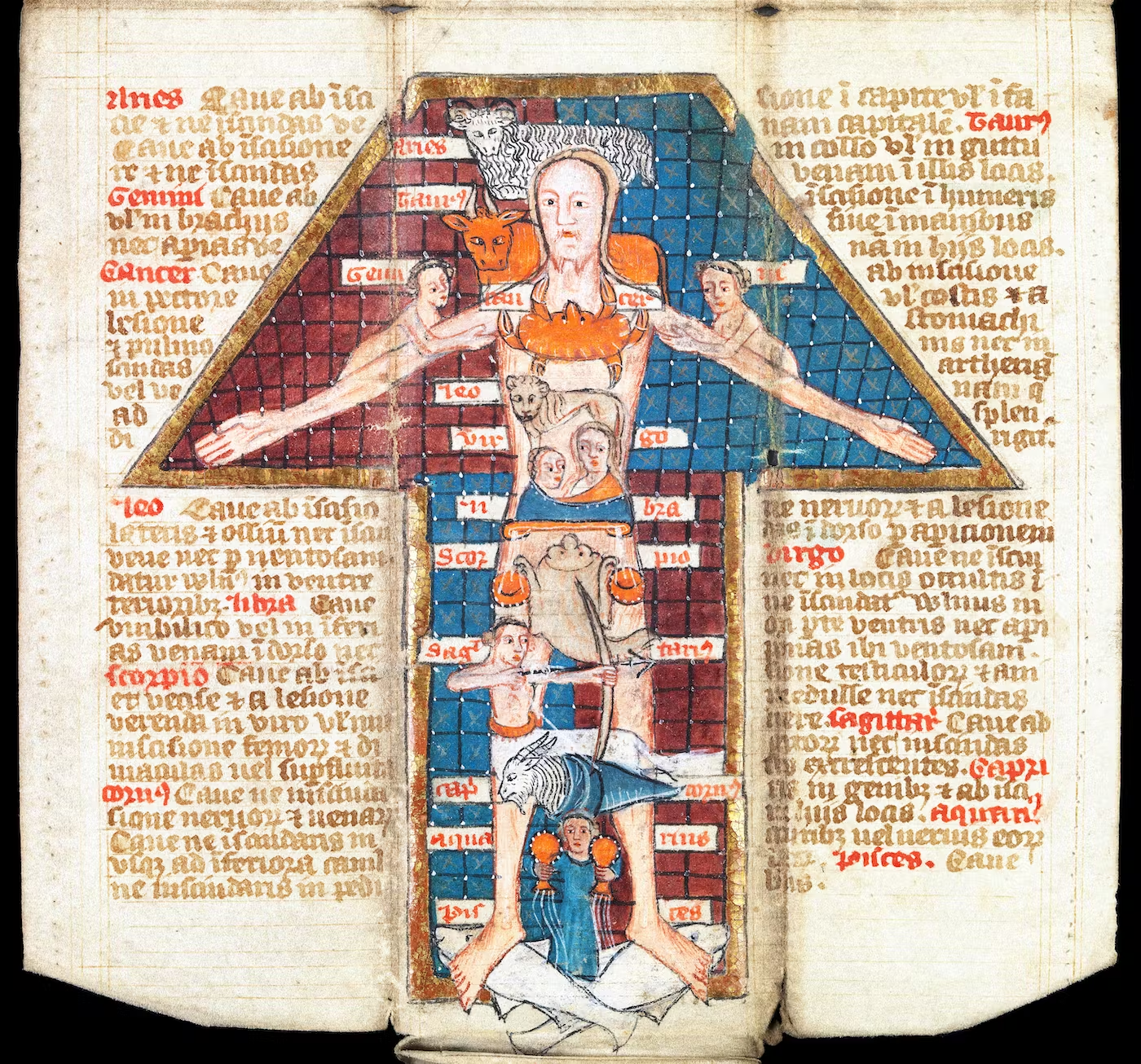
Zodiac Man: figure stands atop two fish representing Pisces, while Leo the lion fills the heart and chest cavity, and a muscled Taurus sits coiled around his shoulders: to each body part, its corresponding star cluster.
pg 108
Taxol (chemo drug): version of tree serum that can be poisonous (Janus-faced yew tree)
One arrangement of atoms stops the heart. But scramble the order, add or subtract an element, and it stalls a tumor. This is a species of combinatory sorcery, mystery at the heart of matter.
The self-enclosed loop of my body splits open like a vein and floods into the larger wheel of natural life, mixing my blood with its blood, a universal tumble and whirl, the stars in my cells.
“Quartz Contentment”: essay on stones and dissociation
pg 120
Emily Dickinson, who had an exquisite sense for the grand scheme of things—the infinitely small to the infinitely large—frequently turned to mineral imagery in her meditations on time and mortality.
Poets have always used stones to convey the insensate, mute quality of the dead. But in speaking of death, Dickinson resorts to stone imagery more consistently, more creepily, and more literally than perhaps any other poet in the ENglish language.
pg 130
To see like a stone, in Emily Dickinson’s sense, is not to turn a cold shoulder to the suffering of a sentient earth and the beings that populate it. On the contrary: it is to fine-tune our attention to metabolic entanglements happening far beyond our knowledge. It is to sense those grand scale scoops and arcs that bind together the atoms of the cosmos, including—but no longer reduced to—our own species’ small, borrowed parcel of stardust.
“Lapidary Medicine”: essay on LA and crystals
Charles Leadbeater’s 1927 monograph, The Chakras
- small circles about 2 inches in diameter, glowing dully (in the “ordinary man”)
- blazing, coruscating whirlpools, much increased in size, and resembling miniature suns (in the enlightened man)
“Object Permanence”: death
pg 153
Yet the physics of time tells us that object permanence of any sort is an illusion. Everything disappears in the end, and if our hearts are stuck on things reappearing this is only because of a perspectival error: we lack the long view by which the cosmos is ceaselessly unrevealing itself…Time is just one way we can count the expenditure of energy, the gradual process by which brief islands of tottering homeostasis—my father, me, the earth, the sun—slowly (measured by what clock?) dissolve back into the cosmic current.
All memories are heat traces, and the future is heat that has not yet been kindled or spent. ANother way to think of time’s arrow is that it is a movement from the improbable toward the probable. All things being equal in the universe, the most probable state is the equilibrium of complete entropy, the dissolution of all particular forms, all energy spent.
My father’s life was a slice of cosmic improbability, a glimmer of an event that my own bundle of molecules ahd the random luck to be entwined with, for a season.
“Camera Obscura”
Transclude of 3lede-0019.avifpg 160
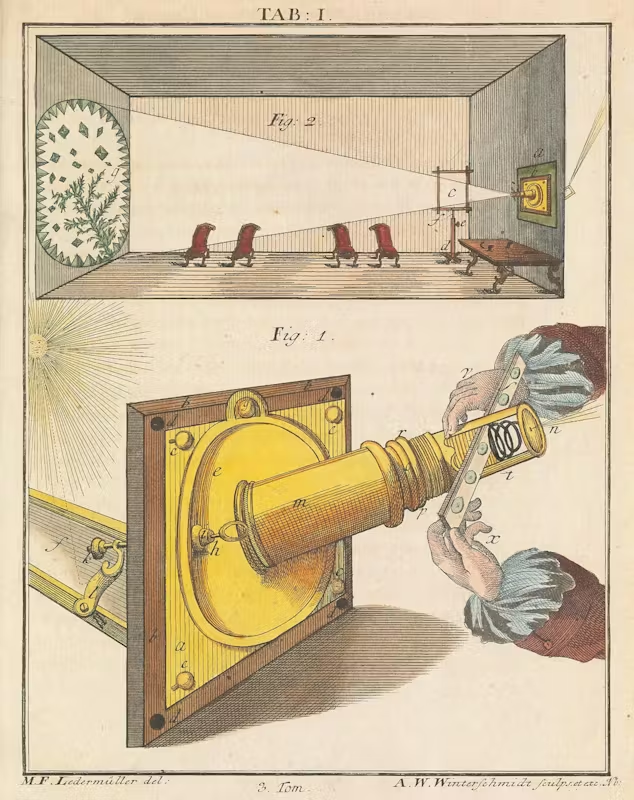
Plato - allegory of the cave - “the mind was lik ethe smooth interior surface of a cave where objects, paraded before a flame, cast their images in a dusky outline like shadow puppets.”
Biological organisms had to learn [to sense, move toward, make pictures out of sunlight] if they hoped to survive in the world at all.
pg 166
These minieclipses [floaters] are a salutary reminder of our embodied state, that we have access to these images—this stream of stuff coming in from the outside, light inscribed on our retina—only because our bodies provide miraculous portals, always subject to obfuscation or closure, onto a world beyond the black box of the self.